

Outsourcing 2.0: The Global Capability Centre Boom in India
India’s transition from just IT outsourcing hub to ‘outsourcing of everything’

Throughout the 1990s and the noughties, India came to the fore as the back-end processor for all things IT and IT services. This happened mainly because in the new millennium for the first time ever, transfer of information over the internet from one corner of the world to the other became super-fast and super cheap. This change opened countless opportunities for businesses across the world to cost-effectively spread out their operations and earn outsized profits.
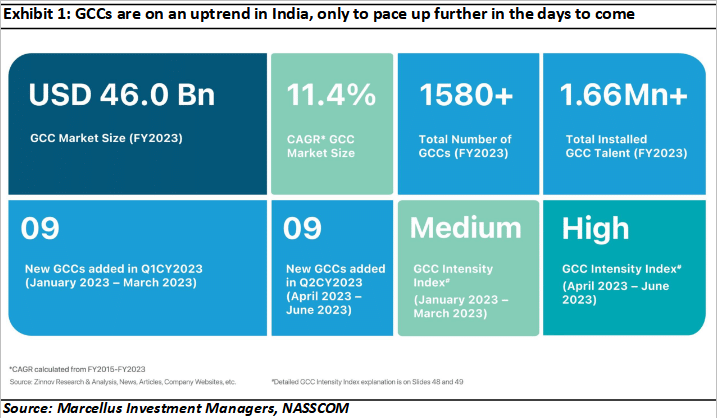
India emerged as a massive beneficiary in this trend with its relatively cheap, yet skilled labour being more than capable of handling IT services for global giants. According to a joint report by McKinsey and NASSCOM in 2005, India accounted for 65% of the total offshore IT industry and 46% of the global Business Process Offshoring (BPO). Fast forward 17 years, and India’s position as an outsourcing hub has only strengthened. According to NASSCOM, there are around ~1600 Global Capability Centers (GCCs) set up in India that employ approximately 2 mn people and generate revenues to the tune of roughly US$ 50 bn p.a. (see exhibit below).
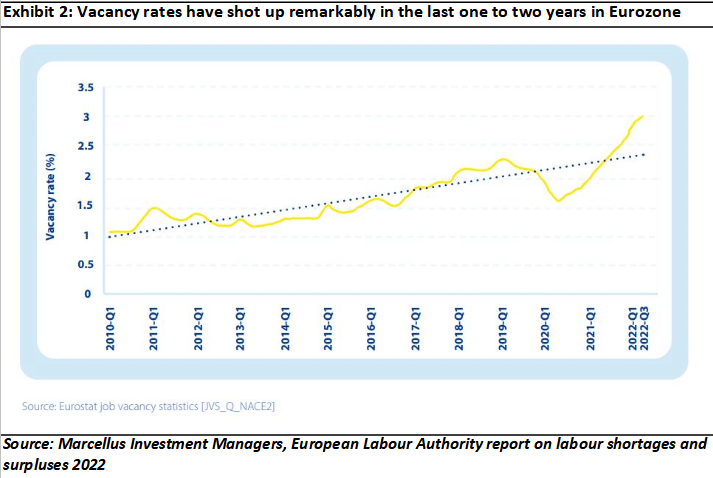
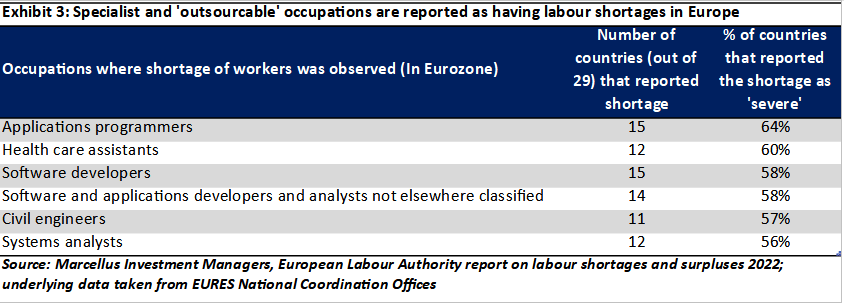
Interestingly, whilst all of this is happening in India, the West is grappling with massive labour shortages. With western economies coming back to normalcy after lockdowns and a structural lack of required skillsets amongst their citizens, job vacancy rates in the Western economies are shooting up (see exhibits 2 and 3 below for Europe and exhibit 4 for America).
The US is also reeling under similar labour shortage issues, where post the pandemic, people are simply choosing not to go back to work (see more here). If we look from the supply side, the data shows that employment opportunities are well over the unemployment rate (see exhibit 4 below) which means that people willing and able to work are employed but the requirement for personnel has exceeded than what is available in the country.

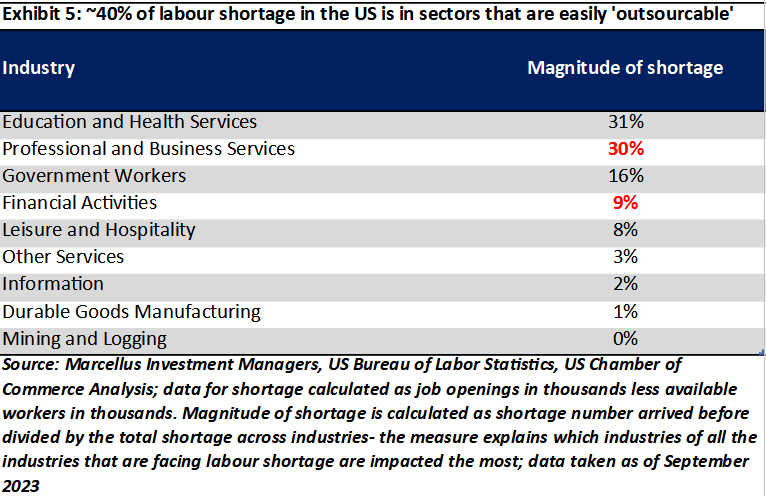
Moreover, the European trend of shortage of skilled workers is more or less true for the American economy as well, with around 40% of the shortage in workers being in professional and business services and financial activities (see exhibit below).
Given the kind of jobs for which the West is facing labour shortages and given the West’s hostility to migration from Asia, it is but inevitable that many of these jobs will end up being outsourced to India.
Indian GCCs are now serving a diverse set of functionalities (beyond IT services): GCCs today in India can handle functionalities like HR, payroll, marketing, manufacturing etc. (see exhibit below).
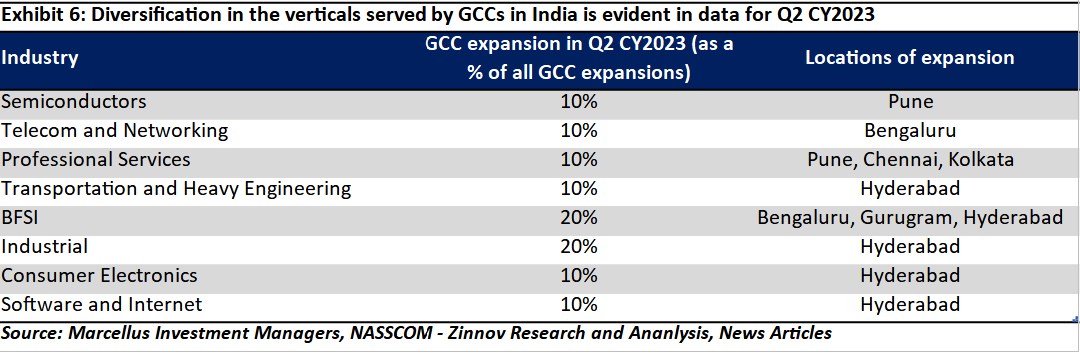
As we travel around India and speak to real estate developers (who are busy finding office space for the GCCs), bankers (who are busy building banking lines into the GCCs) and recruiters (who are busy finding talent for the GCCs), we can see the ongoing surge in GCC numbers in India.
To give some context here, if we take the 85 GCCs set up in the last 12 months (source: NASSCOM report), it will appear that India is on a run-rate wherein a brand new GCC is setting up shop every 5 days.
Investment implications Given the infra & lifestyle issues posed by the Tier 1 cities (e.g., long commutes, high population density, high cost of living) and given the improvement in road & airline connectivity to Tier 2 cities, it is but natural that we are now seeing GCCs coming up in cities like Indore, Nashik, Tirunelveli, Coimbatore and so on (see exhibit below). Note in the exhibit below, the preponderance of GCCs in India’s ‘southern seven’ states underscoring the preference of foreign investors to set up shop in those parts of the country where: (a) law & order is a given, (b) there is high availability of skilled talent, and (c) physical infrastructure is in a relatively much better shape. As explained in our August 2023 blog The Explosive Ascent of Southern India, southern India ticks all of these boxes.
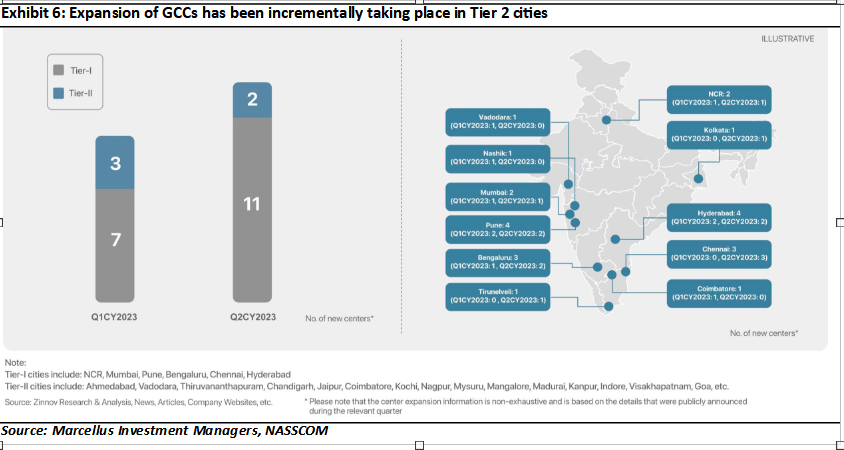
With more such GCCs being set up in tier 2 towns in the country, more employment opportunities are going to be created. Going by NASSCOM’s estimate that around 2 million people currently work in India in GCCs, if GCCs continue growing at the rate that they have (i.e., adding ~100 GCCs each year) then five years hence it is likely that a further six lakh Indians will find employment in GCCs.
Assuming that each of these jobs pays on average Rs 7 lakh p.a. and assuming the GCC boom sustains over the next five years, such employment will inject into the Indian economy an additional $9 bn per annum (for the next five years). Applying on this the standard Keynesian fiscal multiplier of 2.3x (to account for the spillover benefits of these GCC employees’ spending on leisure & consumption) suggests a benefit to the Indian economy of $20 bn per annum i.e., 0.4% p.a. of GDP five years out.
Disclaimer: The authors work for Marcellus Investment Managers. Views are personal.
Download Money9 App for the latest updates on Personal Finance.
